


Traditional qualitative research gives you a choice. You can run one-to-one interviews, which are honest but slow and expensive. Or you can run a focus group, which is faster but comes with a problem everyone in research knows about: the room.
The trouble with the room
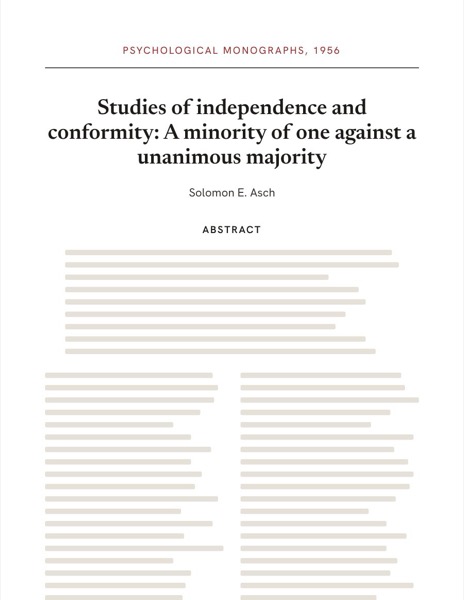
Put eight people around a table and they influence each other. The confident person speaks first, the others adjust. Solomon Asch (opens in a new tab) documented this pressure in his famous conformity studies (opens in a new tab), where people went along with an obviously wrong majority. Good moderators fight it with techniques like having people write answers before discussing, as recommended in the standard guide Focus Groups (opens in a new tab) by Krueger and Casey. But the room never fully goes away.
One to one, all at once
Cast removes the trade-off. Every AI user is interviewed privately by the Director, and all of the interviews run at the same time. Nobody hears anyone else's answers. Twelve people means twelve independent conversations, not one conversation with twelve listeners. You can watch them happen live, side by side, and open any transcript the moment it finishes.
Why speed changes the questions you ask
A traditional focus group commonly costs "between $4,000 and $12,000" (opens in a new tab) and takes weeks to recruit and run. At that price you get one shot, so you test the idea you already believe in. When a study takes about an hour, you can test three positioning ideas before lunch, keep the one that survives, and test its pricing in the afternoon. Speed does not just save time; it makes you braver about what you test.
And the follow-ups
Real interviews end when the participant leaves. AI users do not leave. When a pattern appears in the findings, you can go back to any AI user with a follow-up question, and they answer with full memory of the earlier conversation. It is the research equivalent of being able to call someone back the next day, every time.
“Twelve independent conversations, not one conversation with twelve listeners.”
Why twelve?
Twelve is not a magic number, but it is a well-researched one. In a widely cited study, Greg Guest, Arwen Bunce and Laura Johnson asked How Many Interviews Are Enough? (opens in a new tab) and found that, in their sample, most themes had appeared within the first twelve interviews of a fairly homogeneous group. Usability researchers have a similar rule of thumb from Jakob Nielsen, who argued that you only need to test with five users (opens in a new tab) per round to find most problems, and should run more rounds instead of bigger ones.
The lesson from both is the same: many small rounds beat one big one. Cast is built for that rhythm.
What you lose without a room
To be fair, focus groups (opens in a new tab) do have a strength: people react to each other, and sometimes one comment sparks an idea in someone else. Cast gets some of that back through follow-ups. When a pattern emerges, you can put one AI user's objection to the others individually and see who agrees, without the social pressure of saying it in front of a group.
How to run a parallel study well
- Keep each audience fairly focused, so twelve interviews can reach saturation.
- Use two or three audiences when you want to compare segments.
- Read three full transcripts before you read the summary, to get a feel for the voices.
- Use follow-ups to test the strongest pattern with every AI user.
Focus group vs in-depth interview: what the research found
The question of whether to run focus groups or one-to-one interviews is older than most research teams think, and it has been tested directly. In a much-cited 1993 paper, The Voice of the Customer (opens in a new tab), Abbie Griffin and John Hauser compared the two for uncovering customer needs. They found that two one-on-one interviews were about as effective as one focus group, and that the expected group synergies did not seem to show up, while noting that their focus group result could be a false negative. They also estimated that interviews with 20 to 30 customers should identify 90% or more of the needs in a fairly homogeneous segment.
Later work pointed the same way. Emily Namey, Greg Guest and colleagues compared the methods for cost and thematic saturation in Evaluating Bang for the Buck (opens in a new tab). Their study reached about 80% saturation with eight individual interviews or two to four focus groups, and individual interviews came out 12 to 20% cheaper. And in Code Saturation Versus Meaning Saturation (opens in a new tab), Monique Hennink and colleagues found that code saturation, hearing all the main themes, came at nine interviews, while meaning saturation, really understanding them, took between 16 and 24.
That last distinction is worth holding on to. Hearing a theme once is not the same as understanding why it matters. Parallel interviews make it cheap to get past the first and toward the second.
What focus groups are still good for
Fairness matters here. Jakob Nielsen's essay on focus groups in UX research (opens in a new tab) argues they are a poor way to judge usability, because they capture what people say rather than how they behave, but he also notes they can be useful for learning what users want and how they feel. Groups can spark ideas, reveal shared language, and show how people talk about a category among peers. Cast does not try to replace that dynamic. It gives you the private version first, so you go into any real group already knowing which themes are worth discussing.
A walk-through: one afternoon, three rounds
Imagine a founder in Baku planning a subscription service for home plant care. Here is how an afternoon of parallel studies might look:
- Round one: twelve AI users, two audiences, asked about how they look after plants today and what goes wrong. Within minutes she sees that most problems are about watering while traveling, not choosing plants.
- Round two: she rewrites the concept around travel, and runs a fresh study with a new cast. Skeptics question whether a stranger should have a house key, which becomes the main objection.
- Round three: she uses follow-up questions to ask every AI user from round two how they would feel about a self-watering kit with no visit at all. Several who rejected the visit model are interested.
In a traditional setup, round one alone might take weeks to recruit and run. Here the whole sequence fits in an afternoon, and she ends it with a sharper concept and a short list of questions for real customers. The example is hypothetical, but the rhythm is the reason parallel interviews exist.
Glossary
In-depth interview (IDI): a private, one-to-one conversation with a single participant. Focus group: a moderated discussion with several participants at once. Code saturation: the point where new interviews stop adding new themes. Meaning saturation: the point where you understand those themes well enough to act. Parallel interviewing: running many independent one-to-one conversations at the same time.
Limitations
Saturation studies were done with real people, and their numbers are guides, not laws. A synthetic cast reaching the same themes again and again may reflect a narrow setup as much as a settled market, which is why Fuzziness and skeptics matter. Parallel speed is also no excuse to skip real customers. It is a way to arrive at those conversations with better questions.
Questions about parallel interviews
Are the interviews really independent?
Yes. Each AI user is interviewed in a separate conversation and never sees anyone else's answers.
Can I run more than twelve?
Yes, depending on your plan. But more audiences usually teach you more than more people in one audience.
How long does a study take?
About an hour from casting to a checked report, including the time the Critic needs to check every line.
Is a focus group or an in-depth interview better for customer research?
For uncovering needs, research by Griffin and Hauser and by Namey and colleagues suggests individual interviews are at least as effective and often cheaper. Focus groups remain useful for hearing how people discuss a topic together.
How many interviews do I need to reach saturation?
Studies suggest the main themes in a focused group often appear within about nine to twelve interviews, while deeper understanding can take 16 or more. Running several small rounds with different audiences is usually more informative than one large one.
Read next: your brief stays yours.


