


Ask a language model what a delivery rider in Dubai pays to rent a bike, and it will give you a confident number. Sometimes that number is right. Sometimes it is from 2021. Sometimes it is invented on the spot. For a chatbot that is an annoyance. For customer research it is a disaster, because every finding downstream inherits the error.
So before an AI user says a single word, our Casting Agent does what a good journalist does: it goes and looks things up.
Retrieval, in plain English
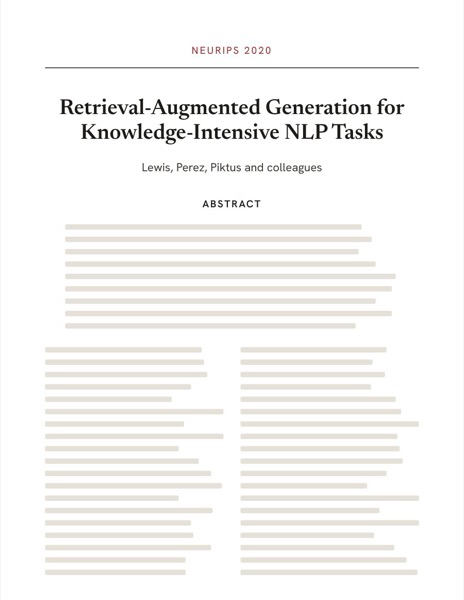
The technique is called retrieval-augmented generation (opens in a new tab). Instead of relying only on what a model memorized during training, the system fetches relevant, current documents and gives them to the model as context. The idea was formalized by Patrick Lewis (opens in a new tab) and colleagues in Retrieval-Augmented Generation for Knowledge-Intensive NLP Tasks (opens in a new tab), which showed that combining a model with a searchable knowledge source produced more specific and more factual answers than the model alone.
OpenAI (opens in a new tab)'s WebGPT (opens in a new tab) pushed the idea further by having a model browse the web and quote its sources, so humans could check the answer instead of trusting it. And researchers at Princeton (opens in a new tab) built a whole benchmark around getting models to cite what they say (opens in a new tab), because a claim you can trace is a claim you can audit.
What gets researched for each AI user
When you cast a fleet manager in Riyadh, the Casting Agent gathers the context someone in that seat would actually live with: typical prices and wages in that city, the regulations that shape their week, how their industry buys, what the seasons do to their business. That research becomes part of the person's backstory. They do not recite it. They simply know it, the way you know what your rent is.
Show your work
Every fact that shapes an AI user keeps its source. In your study you can open any AI user and see where their market knowledge came from. If you think a number is off, you can see why the AI user believed it, and correct it before the interviews run.
“A claim you can trace is a claim you can audit.”
Why it produces better research
Grounding does two things for your results. First, answers become specific: "I pay about 300 a week to a man in Al Quoz" is useful in a way "bikes are expensive" never is. Second, the Critic gets something to check against. When an AI user states a fact, the Critic compares it with the research brief, and anything unsupported gets sent back. That is the difference between a plausible story and a grounded one.
Why models make things up
Language models predict plausible text. Most of the time plausible and true overlap. When they do not, the model produces a confident falsehood, often called an AI hallucination (opens in a new tab)). The risk is highest for exactly the facts customer research depends on: local prices, recent regulation, niche industries and anything that changed after the model was trained.
What good grounding looks like
Grounding is not about stuffing a prompt with web pages. It is about choosing the few facts that shape a person's decisions and making sure they are current and local. For an AI user, that usually means the costs they face, the rules they must follow, the tools they use today and the alternatives they would consider.
- Cost of living and typical wages for the role and city.
- Prices of the main alternatives, including doing nothing.
- Regulations or industry norms that shape the buying decision.
- Recent events in the market, such as a new competitor or a price change.
How to check an AI user yourself
Open any AI user in your study and look at their sources. Ask three questions. Is the source recent? Is it about the right place? Is it the kind of source the real person would trust? If a fact looks wrong, correct it and re-run that AI user. The rest of the study is unaffected.
This habit is borrowed from journalism, where good fact-checkers check the source behind a claim before they check the claim itself. It works for synthetic people too.
How to reduce AI hallucination in research: what the evidence says
If you search for ways to stop a language model from making things up, you will find a lot of confident advice. The honest summary from the research is simpler: you cannot make hallucination disappear, but you can make it rarer and, crucially, easier to catch. A good starting point is the Survey of Hallucination in Natural Language Generation (opens in a new tab) by Ziwei Ji and colleagues, which maps the many ways generated text drifts away from its source and the methods people use to rein it in.
Three findings matter most for anyone using AI in customer research. First, the problem is real even for strong models. When Sewon Min and colleagues built FActScore (opens in a new tab), a method that splits a long answer into small "atomic facts" and checks each one against a trusted source, they reported that ChatGPT reached only 58% on biographies of people. Second, retrieval helps but is not magic. A preregistered study from Stanford (opens in a new tab), Hallucination-Free? (opens in a new tab), found that leading legal research tools built on retrieval still hallucinated between 17% and 33% of the time, which was better than a general chatbot but far from the "hallucination-free" marketing. Third, checking works better when it is done separately. Meta's Chain-of-Verification (opens in a new tab) method has the model plan fact-check questions and answer them independently, so the checks are not biased by the draft, and the authors show this reduces hallucinations across several tasks.
That is the logic behind Cast. Retrieval gives each AI user facts to stand on. Citations let you see those facts. And a separate Critic checks what is said against them.
Why fewer, better facts beat a pile of documents
It is tempting to think more context always means more accuracy. It does not. In Lost in the Middle (opens in a new tab), Nelson Liu and colleagues at Stanford found that models tend to use information best when it sits at the beginning or end of a long input, and that performance drops when the useful part is buried in the middle. For synthetic users, the practical lesson is to research a short list of facts that genuinely shape a person's decisions, rather than handing the model a stack of web pages and hoping it finds the right line.
A walk-through: grounding one AI user
Imagine a founder building scheduling software for independent physiotherapy clinics in Istanbul. One of her AI users is a clinic owner with three treatment rooms. Before that person is interviewed, the Casting Agent looks for the handful of things a real owner would carry around in their head:
- What clinics like this typically charge per session, and what they pay their staff.
- How appointments are booked today, for example by phone, messaging apps or an existing booking tool.
- Any rules that affect patient records or appointment reminders.
- What alternatives cost, including a part-time receptionist.
Each fact keeps its citation. When the owner later says something like "a missed appointment costs me a full session fee, and I have maybe four a week," the founder can open the AI user, see where the session price came from, and decide whether she trusts it. If the source is old or about a different city, she knows to treat that line with care. The example is hypothetical.
A short glossary
Hallucination: fluent, confident text that is not supported by fact or by the source it claims to use. Grounding: tying what a model says to specific, checkable information. Retrieval: fetching documents at the time of the question rather than relying on what the model memorized. Citation: a record of where a fact came from. Knowledge cutoff: the point after which a model has not seen training data, which is why recent prices and rules need retrieval.
Honest limitations
Grounding is only as good as the sources behind it. Public web sources can be out of date, thin for niche industries, or skewed toward places that publish more online. Some facts that matter most, such as what a specific company pays a supplier, are rarely public at all. Citations do not remove these gaps. They make them visible, which is the most a research tool can honestly promise. Treat an AI user's facts the way you would treat a well-briefed interviewee's: useful, specific, and worth checking before you bet on them.
Questions about sources
Where do the sources come from?
Public web sources such as government statistics, industry reports, price listings and news. Cast does not access private or paywalled data unless you add it to your brief.
Can I add my own data?
Yes. Anything you put in the brief, such as your own survey results or market notes, becomes context for casting, and it stays private to your workspace.
What if sources disagree?
The Casting Agent picks the most recent and most local source and records the alternative. Disagreement between sources is often a useful finding in itself.
Does retrieval eliminate AI hallucination?
No. Research on retrieval-based tools shows it reduces errors but does not remove them. That is why Cast keeps citations and adds a separate Critic, so the remaining errors are easier to spot.
What makes a good source for a synthetic user?
One that is recent, about the right place and the right kind of person, and the sort of source that real person would recognize, such as official statistics, industry bodies, price listings or local news.
Read next: the Critic who reads every line.


